
Reviewed · WALKING TOURS
Private Walking Tour of Dubrovnik Hidden Gems and History
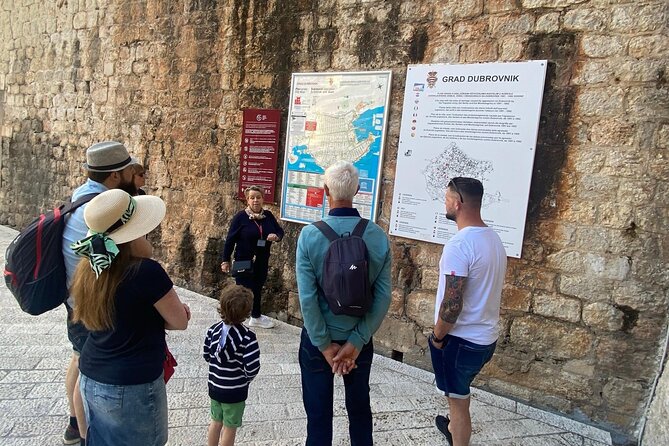
Dubrovnik clicks when someone tells the right stories. This private 2-hour walk strings together Old Town history and everyday details, from medieval fortifications to how the city once got its drinking water. I especially liked that the guide keeps the tone human, and you get real context, including the background of the war that shaped the city.
My favorite part was the combination of big landmarks and quiet corners. You’ll hit the entrance drama at Pile Gate, then slow down for places like Onofrio’s Fountain masks and the Franciscan pharmacy cloister. The one drawback to plan for: optional museum and church interiors cost extra, and a couple stops are view-only, like the Rector’s Palace exterior.
In This Review
- Key Things You’ll Notice on This Dubrovnik Walk
- Why This 2-Hour Dubrovnik Walk Works for First-Time Visitors
- Meet at Amerling Fountain and Start at the City’s Main Threshold
- Pile Gate to Onofrio’s Fountain: Defense to Drinking Water
- Franciscan Monastery Museum and the Old Pharmacy You Can Add
- Stradun and Sponza Palace: Where the Republic’s Power Shows Up
- Church of Saint Blaise and Dubrovnik’s Patron-Saint Symbol
- Rector’s Palace Exterior Stop: A Quick Power Lesson
- Dubrovnik Cathedral and the Old Port Views Under the Walls
- Finish at the Bell Tower, Watch Maro and Baro Do Their Hourly Job
- Price and Value for a Private Group Up to 6
- Who This Tour Is Best For
- Should You Book This Dubrovnik Private History Walk?
- FAQ
- What’s the tour duration?
- How many people are in a group?
- What language is the tour offered in?
- Where does the tour start and where does it end?
- What time does the tour begin?
- Is an entrance fee included for museums or churches?
- Does the tour enter Rector’s Palace?
- Is a mobile ticket provided?
- Are service animals allowed?
- Is free cancellation available?
Key Things You’ll Notice on This Dubrovnik Walk
- Private group with personalized pacing for up to 6 people
- Pile Gate and Dubrovnik’s defensive design, not just a quick photo stop
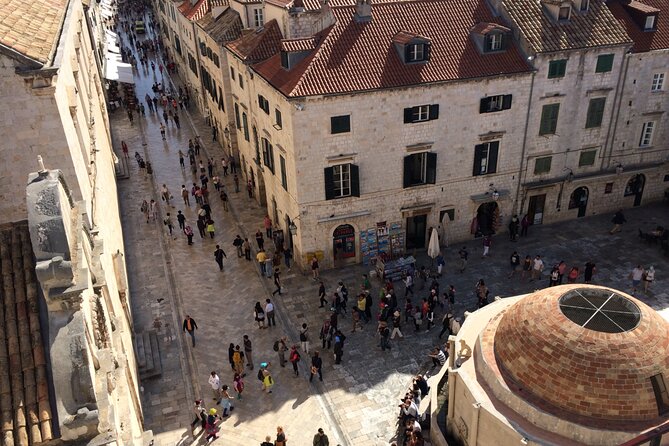
- Onofrio’s Fountain water system story, with the 16 carved masks that once delivered drinking water
- Franciscan Monastery Pharmacy is optional, so you can choose quiet time or extra ticket time
- Stradun to Sponza area, where the Republic’s civic life shows up in stone and arches
- Finish at the Bell Tower, including the hour-striking Green Men, Maro and Baro
Why This 2-Hour Dubrovnik Walk Works for First-Time Visitors
Dubrovnik is famous, but it can also feel like a blur of walls, steps, and crowds. This tour is built for focus. In about two hours, you get a guided line through the Old Town that helps you understand what you are seeing, and why it mattered.
I like that it is not just dates and titles. You spend time at meaningful stops, but the guide also ties them to practical city life: defense at the entrance, water supply mechanics at the fountain, and the way religious and civic power sat side by side. Even if you only have a short window in port, this is a solid way to get bearings fast.
The tour is also truly private. If your group wants more time at a specific corner, or you have questions that branch off into politics, the guide can adjust. That matters in Dubrovnik, where one wrong turn can cost you the whole morning.
Meet at Amerling Fountain and Start at the City’s Main Threshold
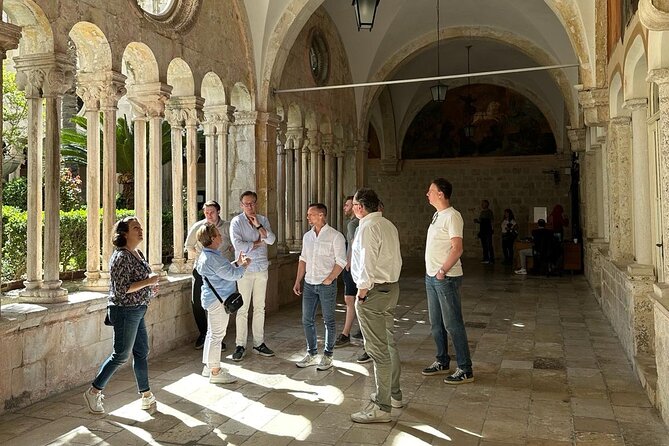
You start at Amerling Fountain in Dubrovnik, then head toward the historic core. The first stop is Pile Gate, the main entrance to Old Town fortifications. It is the kind of place where you immediately understand Dubrovnik’s mindset: this was a city built to be protected.
Pile Gate dates to the 15th century and sits inside the medieval wall system. You’ll notice the stone bridge and drawbridge style elements, and you’ll also see the statue of St. Blaise, Dubrovnik’s patron saint. For me, the magic is how the gate tells you the city’s priorities before you even reach Stradun.
Practical tip: wear shoes you trust. Old Town stone is beautiful, but it can be slippery when it’s wet and it is hard on tired feet if you rush.
More of the old city crossed on foot:
- Dubrovnik: Old Town Walking Tour
★ 4.8 · 5,174 reviews - Dubrovnik Discovery Old Town Walking Tour
★ 5.0 · 4,458 reviews - Dubrovnik: Game of Thrones Walking Tour
★ 5.0 · 1,732 reviews - Dubrovnik Old Town History Walking Tour
★ 5.0 · 1,684 reviews
Pile Gate to Onofrio’s Fountain: Defense to Drinking Water
From defense to daily survival is a great trick, because it changes what you notice. After Pile Gate, the walk shifts to Onofrio’s Large Fountain.
This fountain was built in 1438 by Italian architect Onofrio della Cava and it is tied to an impressive engineering idea. The system brought fresh water from a spring about 12 kilometers away. That’s not just a fun fact. It explains why Dubrovnik’s public spaces and civic structures were shaped the way they were, because water was life, and life depended on infrastructure.
The fountain’s circular design has 16 carved stone masks. Each mask had a spout that once fed drinking water into the city. The guide will talk through how this worked during the time of the Dubrovnik Republic, and you’ll get a better sense of what people relied on every day.
Possible drawback to keep in mind: the tour is short and the best stories take time. If you love to linger for photos, you may want to choose between extra photos and full explanations, since the stops are paced to fit everything in.
Franciscan Monastery Museum and the Old Pharmacy You Can Add
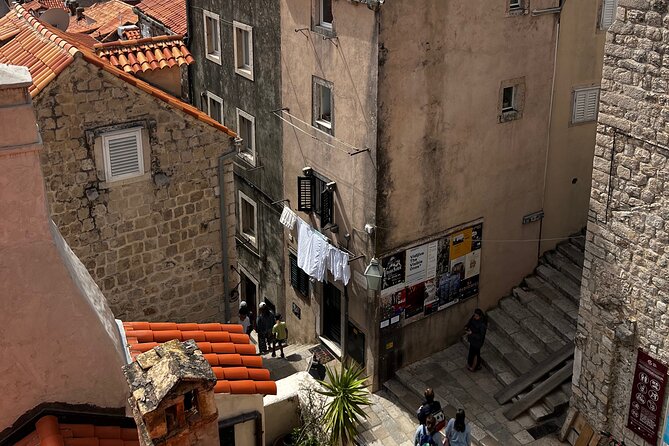
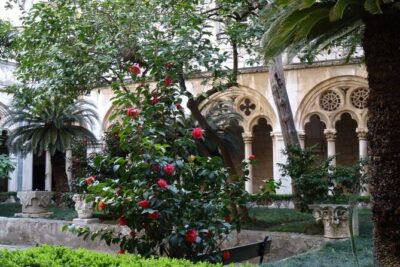
Next up is the Franciscan Monastery. The monastery complex dates back to the 14th century and is known for its calm cloister and a famous pharmacy.
Here’s the key detail: this is an optional deeper stop. You can visit the old pharmacy and the monastery spaces, but the admission fee is not included. If you choose to enter, you’ll spend time in one of the oldest still-functioning pharmacies in Europe, established in 1317.
Even if you skip the interior ticket, the monastery setting still provides a useful contrast to the busy Old Town streets. The cloister vibe is the kind of break that makes history feel personal, because it is quieter than you expect.
My advice: if you like museums that feel like rooms people lived in, not just exhibition halls, do the pharmacy. If you’re traveling with limited time, or you want more open-air walking, you can pass on the optional entry and keep momentum.
Stradun and Sponza Palace: Where the Republic’s Power Shows Up
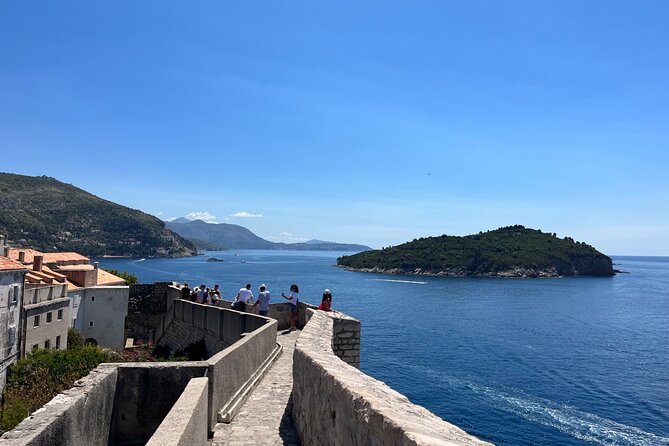
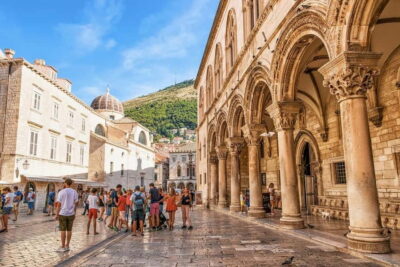
Then you hit Stradun, the main promenade of Dubrovnik’s Old Town. It is a wide limestone-paved street that runs through the heart of the city. Stradun is the social and cultural center, but the tour helps you see it as more than a shopping strip.
You’ll learn stories connected to the street itself, and you’ll also understand why Stradun works the way it does: it is a public spine where civic life and everyday movement happen in one place.
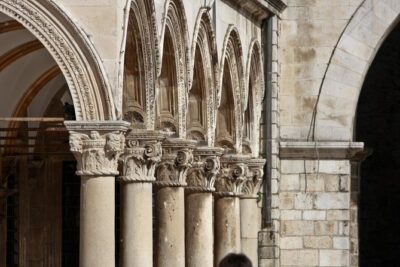
A short walk from Stradun brings you to Sponza Palace, a 16th-century building that mixes Gothic and Renaissance architecture. You’ll stand at a point that helps you connect style with function. Sponza once served as a customs house and treasury, which makes it a key piece of Dubrovnik’s trade-and-administration world.
Today, the building holds Dubrovnik’s historical archives and spaces linked to memorial moments for Dubrovnik defenders, and it also functions as a cultural venue. Even if you are not going inside on this tour, the exterior and its location anchor a big part of the city’s story.
Tip: if you are the type who tends to speed-walk streets for photos, Stradun is where you should slow down. The guide’s stories make the street feel like a pathway through power, not just a walkway.
Church of Saint Blaise and Dubrovnik’s Patron-Saint Symbol
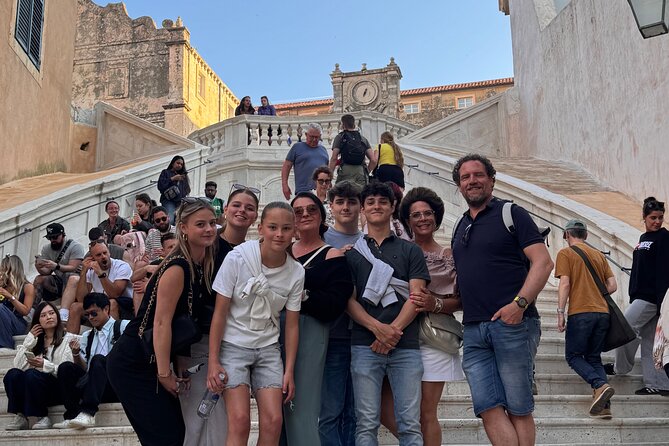
Next you’ll visit the Church of Saint Blaise. The current structure is from the early 18th century and it is Baroque in style. This stop matters because St. Blaise is not a decorative footnote in Dubrovnik, he is part of the city’s identity.
Inside the church, the focus is a treasured statue of Saint Blaise holding a model of medieval Dubrovnik. That image is basically the city saying, our protector watches over our fate. The guide explains the meaning behind that symbol and how it fits Dubrovnik’s sense of itself.
Since you are not paying extra to include this stop, it’s a great place to get a feel for religious symbolism without turning your tour into a ticket collection. Just manage expectations: you’ll spend time learning outside and around the church area, and if you want interior time, you can decide based on your schedule and priorities.
More of the Republic that ran this coast:
- Game of Thrones & History of Dubrovnik Tour★ 5.0 · 628 reviews
- Dubrovnik: Old Town History Walking Tour★ 4.9 · 474 reviews
- Early Bird Dubrovnik History Tour – 7:30 Start★ 5.0 · 198 reviews
- Dubrovnik: Red History Museum Regular Ticket★ 4.6 · 134 reviews
- Dubrovnik Jewish Heritage Private Walking Tour★ 5.0 · 121 reviews
Rector’s Palace Exterior Stop: A Quick Power Lesson
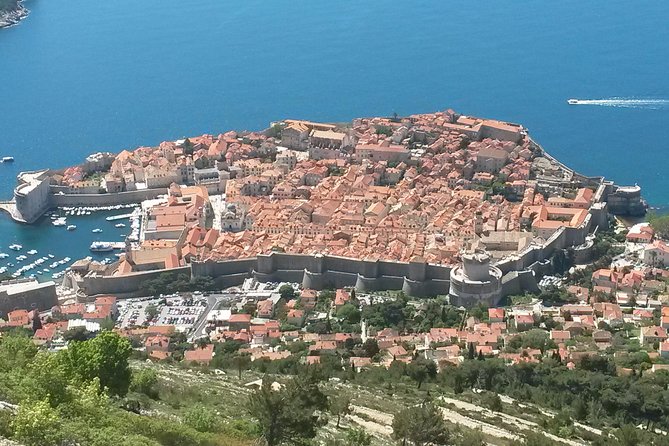
You also stop near the Rector’s Palace. This building blends Gothic, Renaissance, and Baroque elements, and it once served as the seat of the Rector, the leader who governed the Republic of Ragusa.
Important detail: the tour does not enter Rector’s Palace. You’ll stop in front, so think of this as a guided orientation moment. It’s still worth it. Standing at the right angle helps you read how the palace signals authority without needing to cross a ticket barrier.
If you love architecture, this quick exterior moment can be more satisfying than you’d think. It gives you a mental map for what you might later want to explore on your own.
Dubrovnik Cathedral and the Old Port Views Under the Walls
After the Rector’s Palace viewing stop, you’ll head to the Cathedral of the Assumption of the Virgin Mary, also called the Assumption Cathedral. The cathedral was rebuilt in the 18th century after an earthquake, and it is grand and Baroque.
The tour provides a chance to connect the cathedral to the broader story of the city’s resilience and rebuilding. The cathedral houses a treasury with relics, including those of Saint Blaise, and a painting attributed to Titian.
This stop includes an optional visit to the cathedral. That means you can choose how deep to go. If you are the kind of person who wants to see the treasury and the interior setting, plan to spend extra time. If you just want the guided context and exterior understanding, you can keep things moving.
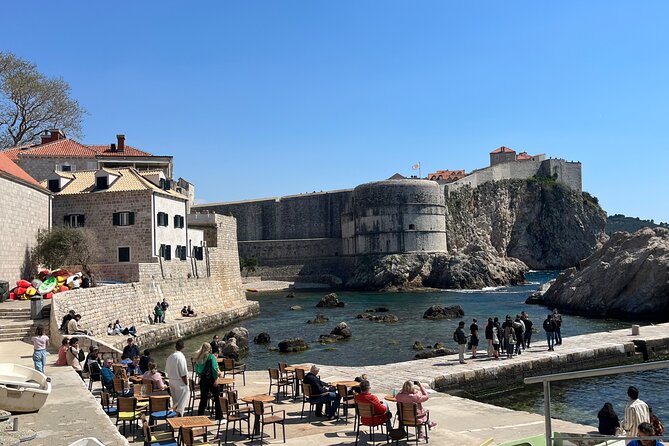
Finally, the tour reaches the Old Port of Dubrovnik, beneath the city walls. This is the practical counterpoint to everything you saw above. The port was central for trade and naval power during the Republic of Ragusa. Today, it is picturesque, with boats, cafés, and connections to scenic island excursions.
I love this ending zone because it turns the story outward. The wall walk begins as protection, then the fountain shows survival, then the civic buildings show governance, and the port returns you to commerce and movement.
Finish at the Bell Tower, Watch Maro and Baro Do Their Hourly Job
Your last stop is the Bell Tower of Dubrovnik, standing about 31 meters tall. It was originally built in the 15th century, then reconstructed in the 1920s after earthquake damage.
At the top are bronze figures known as the Green Men, or Maro and Baro. They strike the bell every hour. Even if you catch the end of the hour schedule, the moment is still memorable because it’s a built-in rhythm that makes time feel local.
This is a fitting finale. You start at the city’s threshold and you end at a tower that literally marks hours. By the time you get here, you are no longer looking at Dubrovnik as just postcards. You are seeing it as a functioning place shaped by defense, faith, water, trade, and rebuilding.
Price and Value for a Private Group Up to 6
This tour costs $228.05 per group for up to 6 people, and it runs about two hours. That is private pricing, so the real value depends on how many people you bring.
If you fill the group, the cost per person becomes much easier to swallow, and you get the benefits of a tailored, question-friendly guide in a compact time window. If you are only booking for two, the per-person number is higher, but you still pay for a guide who can keep the pacing tight and adjust to your interests.
The included guide service is the heart of the price. This is not a multi-ticket museum marathon. Most of the stops have admission free access listed for the time you spend there. The optional pieces, like the Franciscan monastery pharmacy visit and the cathedral interior, are where you might add costs based on your curiosity.
For me, the biggest value is the guide quality. I saw a clear theme in experiences: the guide can explain not just monuments, but also how the city was shaped by major events, including the war context. That depth turns Dubrovnik from scenery into understanding.
Who This Tour Is Best For
This private walk is a great fit if:
- You want a short, structured Old Town introduction without getting lost
- You care about the meaning behind landmarks, not just photos
- You prefer a guide who answers questions and adjusts to your group
- You want a mix of fortifications, civic power, and religious symbolism in one loop
It may be less ideal if:
- You plan to spend long stretches inside multiple attractions, since entry fees for optional sites are not included and the tour time is tight
- You want a deep architecture study session, because a couple stops are exterior only, like Rector’s Palace
Should You Book This Dubrovnik Private History Walk?
If you have two hours and you want your Dubrovnik visit to make sense, I think you should book it. The timing works, the stops line up in a logical story from Pile Gate to bell tower, and you spend enough time at each place to learn without feeling rushed.
I also like that it is private and small, up to 6 people, so you do not get swallowed by the largest crowd in the oldest streets. And based on how guides like Antje van Berkel-Crvik are described, you can expect both passionate storytelling and practical tips for what to do next in Dubrovnik.
Just go in knowing the tour includes guided viewing at many spots, with optional interior time at specific sites. If you budget for that if you want it, you will get a smooth, satisfying Old Town walk that you can build the rest of your trip around.
FAQ
What’s the tour duration?
The tour is listed as approximately 2 hours.
How many people are in a group?
It’s a private tour for up to 6 people.
What language is the tour offered in?
It’s offered in English, with quality private guide services also available in Dutch-NL or French.
Where does the tour start and where does it end?
It starts at Amerling Fountain (Ul. Svetog Đurđa, 20000 Dubrovnik) and ends near the Clock Tower of Dubrovnik, close to the Bell Tower.
What time does the tour begin?
The start time is 9:00 am.
Is an entrance fee included for museums or churches?
Entrance fees are not included for optional museum and monastery visits. Some stops are admission free, but optional interiors may cost extra.
Does the tour enter Rector’s Palace?
No. You stop in front of Rector’s Palace, but the attraction is not entered.
Is a mobile ticket provided?
Yes, the tour includes a mobile ticket.
Are service animals allowed?
Yes, service animals are allowed.
Is free cancellation available?
Yes, you can cancel up to 24 hours in advance for a full refund.
New around Dubrovnik

Walking Tours, compared.

City Walls Early Morning or Sunset Walking Tour
Read our review →
City Walls, Old Town Walking Tour & Adriatic View
Read our review →Browse the lists this tour appears in