
Reviewed · CITY WALLS TOURS
Dubrovnik Medieval Walls Walking Tour
Walls turn history into a hike.
On this Dubrovnik ramparts walk, you get the story behind UNESCO-listed defenses while you enjoy sweeping views over red rooftops and the Adriatic Sea. The result is more than a photo stop. You walk the circuit, learn what the walls protected and how they changed from the 12th century onward, and you see the main forts and towers that shape the skyline.
I especially like the small-group feel (up to 12 people). It keeps the pace comfortable and makes it easier to hear your local guide while the city keeps unfolding in every direction. I also like that the tour focuses on specific defensive points, not just a generic stroll along the stones, so the ramparts feel purposeful instead of random.
One possible drawback to plan for: the tour price does not include wall admission. You will pay the entrance fee yourself to climb up, and it can be a little confusing if you arrive with only one payment method or the wrong currency.
In This Review
- Key points before you go
- What you are really paying for on the Dubrovnik Medieval Walls
- Where to start: Pile Gate and the wall admission reality
- The 2-hour ramparts route: how the walk feels in practice
- Stop 1: Minceta Tower, the landside defense with huge Old Town views
- Stop 2: Revelin Fortress and the Ploce Gate problem
- St John Fortress and the seaward wall views over boats
- Fort Bokar, Lovrijenac, and the northern watch
- Why the guide stops matter more than you think
- View strategy: how to enjoy the best panoramas without rushing
- Price and value: is $29 a smart way to do Dubrovnik’s walls?
- Who should book this walls walk
- Quick practical tips before you meet at Pile Gate
- Book this or keep it casual?
- FAQ
- How long is the Dubrovnik Medieval Walls Walking Tour?
- Where does the tour start and end?
- How much is the tour, and is wall entrance included?
- What are the wall entrance fees?
- How long is the walking route?
- How many people are in the group?
- What is included in the tour price?
- Is hotel pickup provided?
- What should my fitness level be?
- Can I cancel and get a refund?
Key points before you go
- UNESCO-listed walls with a guided narrative so you understand what you are seeing.
- Full ramparts circuit in about 2 hours, covering roughly 1.25 miles (2 km).
- Major towers and forts in a logical route, including Minceta, Revelin, St John, and Fort Bokar.
- Big panoramic viewpoints over Old Town rooftops, harbor boats, and the sea.
- Up to 12 people means you are not stuck with a loud herd on narrow wall segments.
What you are really paying for on the Dubrovnik Medieval Walls
Dubrovnik’s walls are famous for a reason. The views are dramatic, yes, but the real payoff is how the walls read like a blueprint of the city’s survival. Without context, you can end up walking the perimeter and thinking, Beautiful, next. With a guide, the stones become a timeline.
This is a 2-hour walking tour with a local guide that takes you along the medieval city walls surrounding Old Town. You learn how construction began in the 12th century and how the defenses were continually extended until the 17th century. That time span matters because each upgrade reflects new threats, new military thinking, and new political pressure.
You also get a clear “where am I and why does it matter” rhythm. Instead of just keeping to the wall edge, you stop at key points where the architecture switches from simple fortification to designed defense: towers, bastions, and forts positioned to cover specific approaches. If you like walking that comes with meaning, this style of tour works well.
Where to start: Pile Gate and the wall admission reality
Your tour starts at Pile Gate (Dubrovvačke Gradske Zidine, 20000, Grad, Dubrovnik). The experience ends back at the same meeting point.
Here is the part that can trip people up: the wall entrance fee is not included. You will pay it yourself to climb to the top of the walls. The listed adult fee is 35 eur (child fee is 15 eur). Your tour ticket is mobile, but you still need that separate access.
I recommend you treat the total cost as:
- the tour price ($29)
- plus the wall admission you pay on your own
Also, be smart about payment. One helpful clue from real-world experience is that the admission amount can be quoted differently depending on currency or how it is presented at the time. Bring a backup plan, meaning some extra cash in the right currency or a second payment option, so you are not stressed at the ticket point.
Other ways around the walls:
- Dubrovnik: City Walls Early Morning or Sunset Walking Tour
★ 4.8 · 1,523 reviews - Dubrovnik: Ancient City Walls & Wars Walking Tour
★ 5.0 · 1,270 reviews - Dubrovnik Combo: Old Town & Ancient City Walls
★ 5.0 · 1,019 reviews - Dubrovnik: City Walls, Old Town Walking Tour & Adriatic View
★ 4.9 · 982 reviews
The 2-hour ramparts route: how the walk feels in practice
The walk covers the full ramparts circuit, about 1.25 miles (2 km). That distance sounds short, and on flat ground it would be. On Dubrovnik’s walls, it is still a real walk because you are often managing steps, uneven stone, and the simple fact that you are stopping for viewpoints and explanations.
The good news: you are not walking for a half day. You get the best hits in a compact time window, which is ideal if you only have one day in Dubrovnik or you already plan to explore Old Town on foot.
The tour is designed around several “read-the-city” stops, so you are not just trudging from one end of the wall to the other. Each stop gives you:
- a defensive feature to recognize
- a reason it exists
- a viewpoint that makes sense for that defense
Your physical level should be moderate. If you can handle a steady walking pace and some steps, you will be fine. If stairs or long standing times are an issue, this is still likely doable, but you may feel it more than you expect because the wall experience keeps you on your feet.
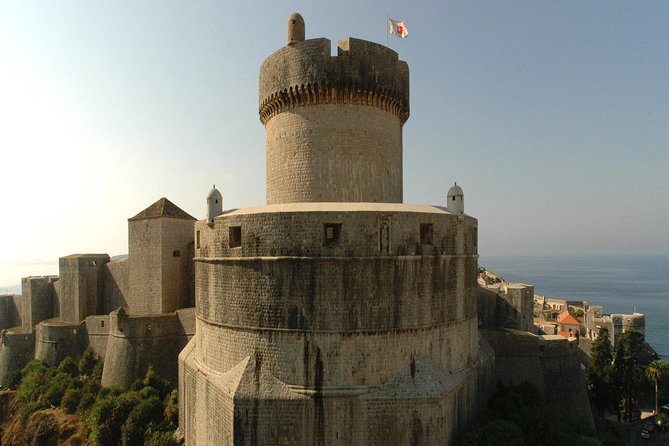
Stop 1: Minceta Tower, the landside defense with huge Old Town views
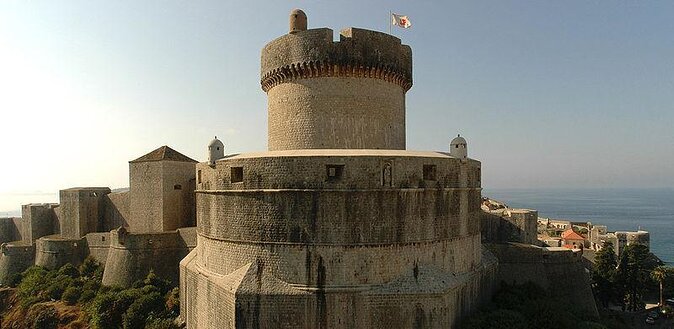
Your first major stop is at Minceta Fortress, specifically the Minceta Tower on the landside, eastern section. This is one of the circular towers that helps protect the city from attacks aimed at its interior side.
Why this stop is worth your attention:
- The tower was built in the 15th century.
- It was designed to help defend against attack from the Ottoman forces.
So you get a concrete example of how the walls adapted over time. You are not just looking at old stone. You are seeing one moment in the long defensive upgrade cycle.
The viewpoint also does double duty. From here, you look down over Old Town’s red rooftops, which instantly shows you the scale of what the walls were protecting. You also see the site of the city’s original Slavic settlement. That adds a layer most wall walks miss. It is not only military architecture, it is the border between where people lived and where the city expected trouble.
One more practical note: landside viewpoints can feel less wind-battered than sea-facing sections, but you will still want to plan for sun and glare. The stones and pale sky can make your phone camera work harder than you expect.
Stop 2: Revelin Fortress and the Ploce Gate problem
Next up is Revelin Fortress, an imposing 15th-century fort built to protect the city’s Ploce Gate from Ottoman pressure.
This stop makes the fortification logic click. Ploce Gate was a key access point, which meant it was also a vulnerability. Revelin acts like a buffer and a protective barrier, helping control who could approach and how.
The tour includes a dedicated time window here, about 15 minutes. That is enough time to:
- orient yourself on where Ploce Gate sits in the broader wall system
- understand why this fort had to be “in the way,” not just along the way
If you enjoy military architecture, this is a strong moment because Revelin is not subtle. It is a statement structure, and you can actually see how it would fit into defense planning rather than just reading about it.
St John Fortress and the seaward wall views over boats
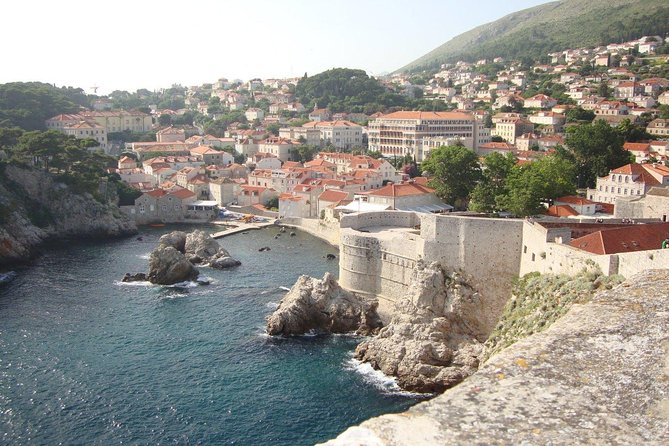
After Revelin, the route continues past the harbor area and toward St. John Fortress. This is your chance to shift perspectives from the rooftops to the waterline.
From the seaward, southwestern walls, you get views over the boats in the harbor and out toward the Adriatic. That matters because Dubrovnik’s defense was never only about one direction. Sea routes, supplies, and approach angles were all part of the threat picture, especially during the periods when the city was extending and strengthening its fortifications.
St John Fortress also gives you a different architectural mood. It is more about controlling maritime access and making sure any approach from the water still runs into obstacle and observation.
If you are the type who likes to understand what you are photographing, this section is useful. The sea-facing views do not just create postcards. They explain why certain parts of the wall look the way they do.
More of the old city crossed on foot:
- Dubrovnik: Old Town Walking Tour★ 4.8 · 5,174 reviews
- Dubrovnik Discovery Old Town Walking Tour★ 5.0 · 4,458 reviews
- Dubrovnik: Game of Thrones Walking Tour★ 5.0 · 1,732 reviews
- Dubrovnik Old Town History Walking Tour★ 5.0 · 1,684 reviews
- Dubrovnik: Game of Thrones Walking Tour★ 4.9 · 981 reviews
Fort Bokar, Lovrijenac, and the northern watch
Finally, you stop at Fort Bokar. This is where you can take in views of Lovrijenac, a separate rock-top fortress that guards the city from the north.
This pairing is excellent for two reasons:
- You see that the defensive system is not one continuous wall with no “neighbors.”
- You get a clear sense of how towers and forts work together across different angles of threat.
Lovrijenac being separate is a key detail. It is a reminder that defense is layered. The walls are the perimeter, but strongpoints inside the system can dominate views, control movement, and complicate any attack plan.
You will finish back near where you started at Pile Gate, so you can then head back into Old Town with your eyes “trained” on architecture instead of just streets and shops.
Why the guide stops matter more than you think
There is a reason this tour includes multiple fort-and-tower stops instead of just saying walk the whole wall. Even if you are an experienced traveler, it is hard to fully interpret:
- why a tower is placed where it is
- why a fort looks like it blocks a specific gate approach
- why the city kept extending defenses up through the 17th century
A guide turns those questions into answers while you are standing at the exact point where the design makes sense. It also keeps the walk from getting monotonous. Dubrovnik is gorgeous, but if you are only scanning for photos, you can miss the logic.
This is also where the up to 12 people size becomes more than a brag. Smaller groups move with less chaos at each stop. You can hear explanations and still take your time looking out over the city without feeling like you are constantly being shooed onward.
View strategy: how to enjoy the best panoramas without rushing
Even on a short wall walk, you can end up moving too fast if you are chasing the next viewpoint. I like pacing like this: let each stop do its job.
At Minceta, look down over the rooftops first, then connect the view to what the tower was protecting. At Revelin, find the gate connection in your mind, not just the fortress shape. At St John, switch focus to sea and harbor. At Fort Bokar, zoom out and study the relationship between Fort Bokar and Lovrijenac.
If you follow that order, the views start feeling less random. Instead, each panorama becomes a piece of the defensive puzzle. You will probably take more interesting photos too, because you will know what feature you are framing.
Price and value: is $29 a smart way to do Dubrovnik’s walls?
At $29, this tour is positioned as a guided add-on, not a luxury experience. The value depends on one thing: you are paying for interpretation and a structured route, and you are saving time you would spend figuring it out yourself.
Because the wall admission is separate, the total experience cost includes both:
- the tour price
- plus wall entrance (35 eur adult, 15 eur child)
Still, for most visitors, the guided element is what makes the difference between walking and understanding. If you love history, military architecture, or simply want your Dubrovnik visit to feel more complete, the guide is the core value.
If you are the type who enjoys self-guided walking and already has a strong plan for what to look for, you might feel the guide is optional. But even then, the tour’s stop selection is practical because it focuses on major defensive points you would otherwise overlook.
Who should book this walls walk
This tour is a strong fit if:
- you want the wall highlights without spending all day on the ramparts
- you like learning why the city was built the way it was
- you prefer a small group rather than a big crowd
- you are visiting Dubrovnik and want the views plus context
It is also a good option if you are combining this with other Old Town exploring, because you get the “big picture” architecture first and can then roam the streets with better orientation.
If you hate stairs or sustained standing, you should think carefully. The wall top experience involves steps and time on foot. The activity calls for moderate physical fitness, so plan accordingly.
Quick practical tips before you meet at Pile Gate
A few things I would do to make the start smoother:
- Arrive a few minutes early at Pile Gate, so you have time to locate your guide without rushing.
- Expect that you will pay wall admission separately, and bring a backup payment option if you can.
- Wear shoes you trust on stone. Your feet do most of the work on this kind of walk.
- Bring water, especially if you are visiting in warmer months, since you will be outside for the duration.
- If you want good photos, be ready to pause quickly at each viewpoint so you are not constantly repositioning.
One more helpful takeaway from real-world timing: sometimes the exact meeting spot near a landmark can be slightly unclear. If you are concerned, I would keep your phone handy in case your guide sends a quick message with the precise location.
Book this or keep it casual?
Book it if you want your Dubrovnik walls visit to feel like a story, with stops that explain what you are seeing. The combination of a structured route, multiple fortifications, and big panoramas in a compact 2-hour window is a smart way to get the best return on your time.
Skip the guided tour only if you are already confident you can identify the key towers and forts and you are fine paying wall admission and learning mostly on your own. If that is you, you can certainly explore the ramparts independently.
My recommendation for most first-time Dubrovnik visitors: yes, book this. It is guided, it stays small, and it turns that famous stone circuit into something you will actually remember for reasons beyond the view.
FAQ
How long is the Dubrovnik Medieval Walls Walking Tour?
The tour lasts about 2 hours.
Where does the tour start and end?
It starts at Pile Gate (Dubrovvačke Gradske Zidine) and ends back at the same meeting point.
How much is the tour, and is wall entrance included?
The tour price is $29, and wall entrance fees are not included.
What are the wall entrance fees?
The entrance fees are listed as 35 eur for adults and 15 eur for children.
How long is the walking route?
You will walk about 1.25 miles (2 km) along the walls.
How many people are in the group?
The group size is capped at a maximum of 12 people.
What is included in the tour price?
The tour includes a local guide.
Is hotel pickup provided?
No, hotel pickup and drop-off are not included.
What should my fitness level be?
The tour is described as requiring moderate physical fitness.
Can I cancel and get a refund?
Yes. Free cancellation is available up to 24 hours before the experience starts for a full refund.
New around Dubrovnik

City Walls Tours, compared.

City Walls Early Morning or Sunset Walking Tour
Read our review →
Dubrovnik Combo: Old Town & Ancient City Walls
Read our review →
City Walls, Old Town Walking Tour & Adriatic View
Read our review →
Dubrovnik Cable Car Ride, Old Town Walking Tour plus City Walls
Read our review →
City Walls Tour for Early Birds & Sunset Chaser
Read our review →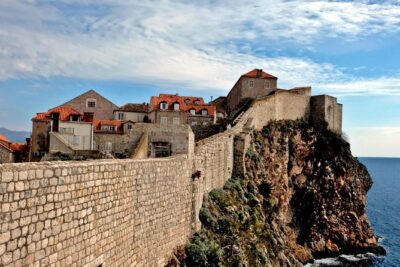
Dubrovnik City Walls Tour for Early Birds or Sunset Chasers
Read our review →Browse the lists this tour appears in