
Reviewed · WALKING TOURS
Dubrovnik Private Small-Group Walking Tour in Spanish
Dubrovnik in 2 hours can still feel meaningful. This small-group private Spanish walk strings together the Old Town sights you actually want to understand, from Stradun to the quieter lanes of Santa Maria. It is a UNESCO World Heritage area story told at a pace that suits your group.
I especially like the way this tour connects the big icons with the everyday geography of the city. You spend time on the main promenade, then shift into local-feeling districts like Buza, plus you get viewpoint moments over the white rocks and toward Lokrum Island.
One practical drawback: with a tight 2-hour window, you will not have hours to wander on your own afterward. If you want a slower, longer day (or wall-walking time that takes more planning), you may still want to pair this with extra time in town.
In This Review
- Key things to know before you go
- Starting at Pile Gate and why Brsalje matters
- Stradun and the city walls: the fast path to understanding Dubrovnik
- Franciscan Monastery to St. Blaise: two ends of the same story
- Onofrio’s Fountains, Sponza Palace, and Orlando’s Column
- Santa Maria and Buza: finding the Dubrovnik locals recognize
- Ulica od Puca on the way back, with shops that still feel old
- The pace, the private group size, and the Spanish guide
- Value for $117 per group, up to 3 people
- What is included, what is not, and how to plan your day
- Who this tour fits best
- Should you book this Dubrovnik Private Small-Group Walking Tour in Spanish?
- FAQ
- Where does the tour meet?
- How long is the Dubrovnik private walking tour?
- Is this tour private?
- What language is the guide?
- What are the main areas you visit?
- What highlights can I expect?
- Is food included?
- Are transfers included?
- Is free cancellation available?
Key things to know before you go
- Private group, Spanish-speaking guide for a tighter pace and tailored explanations
- Pile Gate start means you go straight into the Old Town action
- UNESCO Old Town focus with city walls and major landmarks explained
- Santa Maria and Buza for a more local feeling than the busiest streets
- Views toward Lokrum Island from a door in the Stjepan area
- Ulica od Puca for traditional jewelry shops and small churches on the return walk
Starting at Pile Gate and why Brsalje matters
You meet at the Armerling Water Fountain (Brsalje), right by the entrance to the Old Town near Pile Gate. That is a smart place to begin because Dubrovnik’s layout is easier to read once you are standing where the traffic and history meet.
Pile Gate is the kind of threshold where the city suddenly feels “real,” not just photographed. From there, your guide leads you along Dubrovnik’s elegant main street, Stradun, while also grounding you in the wider picture: the Old Town is surrounded by more than a mile of walls, with a tower at each corner. In other words, you are not only seeing buildings, you are learning how the city defended and shaped itself over time.
You also get a small bonus that matters on a first visit: tourist brochures and maps are included. I like that because Dubrovnik’s streets can look similar until you have a mental map. Even if you plan to go off on your own later, these materials help you keep your bearings.
Stradun and the city walls: the fast path to understanding Dubrovnik
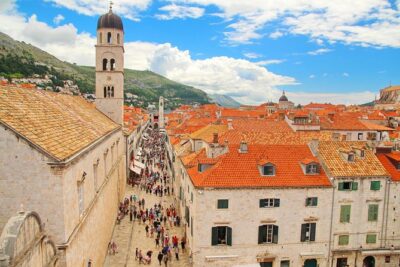
Stradun is Dubrovnik’s signature promenade. Yes, you will see the classic views. But this is where the tour style pays off, because the guide uses the walk to give context, not just spot names.
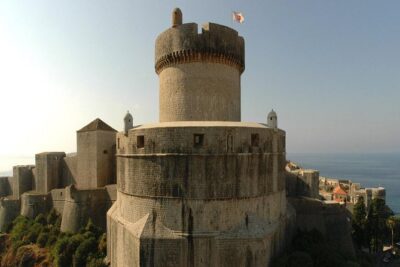
You stroll along the main street and take in the architecture and the scale of the city walls, often described as a masterpiece of Renaissance architecture. Even from ground level, the walls communicate power. They also make it clear why Dubrovnik developed as a contained world. The walk down Stradun helps you feel the rhythm of the city, with landmarks appearing in a sequence that makes sense rather than random.
At the end of Stradun, the tour sets up two big anchors. On one side, you get the Franciscan Monastery area. On the other, you meet the Church of St. Blaise and major civic buildings nearby. That end-to-end structure helps you remember Dubrovnik as a connected route, not a checklist of “must sees.”
If your goal is to get oriented quickly and understand why the Old Town looks the way it does, this part works well. The walk is not just for sightseeing. It is for building a picture you can carry into the rest of your visit.
More of the old city crossed on foot:
- Dubrovnik: Old Town Walking Tour
★ 4.8 · 5,174 reviews - Dubrovnik Discovery Old Town Walking Tour
★ 5.0 · 4,458 reviews - Dubrovnik: Game of Thrones Walking Tour
★ 5.0 · 1,732 reviews - Dubrovnik Old Town History Walking Tour
★ 5.0 · 1,684 reviews
Franciscan Monastery to St. Blaise: two ends of the same story
A tour can make you see Dubrovnik, or it can make you understand it. Here, the Franciscan Monastery and the Church of St. Blaise are used like bookends, framing how spiritual life and civic identity show up in the city.
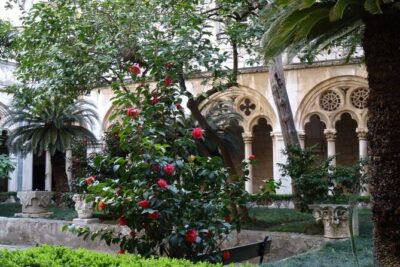
The Franciscan Monastery is approached from Stradun, and you spend time with its cloister, described as one of the most inspiring sites in Dubrovnik. I like that the tour stops for explanation here, because cloisters are easy to treat like a pretty courtyard. With guidance, you notice how the setting creates calm and how it fits into the city’s layers.
Then you reach the other end, where St. Blaise sits within a cluster of major buildings. This section is ideal for photos, but it is also ideal for learning: the guide helps you connect the religious landmark to the surrounding civic spaces. It makes Dubrovnik feel planned, not accidental.
This is also a good moment to keep your pace. Because it is a private group tour, you are not forced into the usual herd movement. You can pause when you want, and the route still stays within the 2-hour time limit.
Onofrio’s Fountains, Sponza Palace, and Orlando’s Column
Dubrovnik loves dramatic monuments, and this tour hits several without turning into a rush-through.
You see Onofrio’s Fountains, which are famous not only for their look, but for what water infrastructure meant in a walled city. In places like this, even a fountain tells a story about daily life and survival.
You also pass Sponza Palace, along with Orlando’s Column. These are the kinds of places where it is easy to glance, take a picture, and move on. With a guide, you get the historical and architectural meaning behind why the buildings sit where they do and why they matter.
Other stops in this Old Town segment include the Bell Tower, the Rector’s Palace, and the Cathedral, plus the Dominican Monastery area. The value here is not the volume of stops. It is the order. The tour sequence helps you understand Dubrovnik’s public face, the governance spaces, and the religious influence in one connected walk.
If you are the type who gets more out of a place when someone explains what you are looking at, this section is a strong reason to book.
Santa Maria and Buza: finding the Dubrovnik locals recognize
The tour’s mood shift is one of its best traits. After the major landmark stretch along Stradun, you head to Santa Maria, described as the oldest district in Dubrovnik. That change matters because it moves you away from the postcard flow and into a more lived-in feeling.
Then comes Buza, a hidden quarter frequented almost exclusively by locals. This is where you start noticing how Dubrovnik looks when it is not framed for visitors. The lanes and viewpoints feel more like a normal neighborhood, not only a museum set.
One of the standout moments is at the door of St. Stjepan, where a view opens out over the white rocks and blue sea, with Lokrum Island visible in the distance. This is the kind of scene that usually takes time to stumble into on your own. Here, it is built into the route, so you get the payoff without guessing where to go.
If your ideal trip includes a mix of iconic sights and one or two places that feel personal, this part hits the sweet spot.
Ulica od Puca on the way back, with shops that still feel old
On the return walk to Stradun, you visit Ulica od Puca. This street is known for traditional jewelry shops, an old barber shop, and small churches.
I like this stop because it gives your brain a break from monumental architecture. It also helps you understand how commerce and daily routines fit into the Old Town. It is not just temples and palaces. People buy things here. People keep traditions here.
From a practical angle, it can also be a good moment to slow down. You can browse without feeling like you are detouring far from the route. Just remember that the tour is only 2 hours, so use the time for quick, meaningful wandering rather than expecting a long shopping session.
Some other walled-city days to weigh
- Mostar and Kravice Waterfalls Tour from Dubrovnik (Semi-Private)★ 5.0 · 3,125 reviews
- Dubrovnik: Blue & Green Caves Private Boat Tour with Drinks★ 4.7 · 814 reviews
- Dubrovnik Private Speedboat Tour to Elaphite Islands with Drinks★ 5.0 · 660 reviews
- Private Tour: Montenegro Day Trip from Dubrovnik★ 4.5 · 495 reviews
- Tour The Game of Thrones – Private Walking Tour★ 5.0 · 464 reviews
The pace, the private group size, and the Spanish guide
This is a private group tour for up to 3 people with a Spanish live guide. That small size changes how the walk feels. You are not waiting for stragglers, and you are not competing with other groups for the best speaking spots near landmarks.
The Spanish-language format is especially helpful if you want more than surface facts. The guide is there to answer questions and explain what you are seeing in a way that sticks. Many people highlight how guides like Patricia (and also mention Ankica) make the experience feel complete by going beyond the basic script.
You also get a guide who seems to work like a local partner, not a timed announcer. People specifically note extra care with questions and photos during the walk, plus practical recommendations for enjoying Dubrovnik beyond the tour route.
That said, private tours mean you should be ready to move with intention. If your group prefers frequent long breaks, you might hit the time limit before you fully go beyond the plan.
Value for $117 per group, up to 3 people
The price is $117 per group, covering a private walking tour for up to 3. On paper, it can look steep if you are comparing only per-person costs. But compare it to what you get here: a guided, Spanish explanation of a UNESCO Old Town route that includes major landmarks, plus a viewpoint moment toward Lokrum through Santa Maria and Buza.
The value improves when you split it among a small group. Two or three people getting the guide attention and the tight route planning can feel like a better deal than paying individually for a larger group tour, especially in Dubrovnik where time is often tight.
Also, the included extras matter more than you might think: brochures and maps are provided, and the whole thing is paced to fit a 2-hour window. If you are trying to make the most of a limited time schedule, that structure is part of the bargain.
What is included, what is not, and how to plan your day
Included:
- Private walking tour with guide in Spanish
- Tourist brochures and maps
Not included:
- Transfers
- Food and beverages
- Souvenirs
Because transfers are not included, plan to arrive at the Old Town entrance area on your own. The meeting spot near Pile Gate is convenient, but it is still inside Dubrovnik’s historic core, so you will want to time it around how you are getting in and out.
For the rest of the day, think of this tour as a foundation. Once you have the Stradun route and the city-wall context, you can better choose where to linger. If you want a longer photo session at any one viewpoint or building area, you can use the tour to identify your top stop for later.
Who this tour fits best
This one is a great match if you:
- Want a Spanish guide and like asking questions during the walk
- Prefer private pace over a larger group schedule
- Are short on time and want the most important Old Town sights connected by story
- Like a mix of famous landmarks and a quieter district like Buza
It may be less ideal if you want a long, slow roam, or if you expect a tour that feels like a full-day deep architectural survey. Here, you get a strong orientation and key highlights in 2 hours.
Should you book this Dubrovnik Private Small-Group Walking Tour in Spanish?
If your first goal in Dubrovnik is to get the lay of the land, understand what you are looking at, and still see the viewpoint story toward Lokrum Island, I think you should book it. The route is built to connect the major sites along Stradun with the older, more local-feeling side of town in Santa Maria and Buza.
Choose it if you value private guide attention and want the experience to feel complete without dragging your day. Choose something else only if your schedule allows longer exploration or if you prefer to spend more time self-guiding after you arrive.
FAQ
Where does the tour meet?
You meet at the Armerling Water Fountain (Brsalje), meters from Pile Gate, at the entrance to the Old Town of Dubrovnik.
How long is the Dubrovnik private walking tour?
The tour lasts 2 hours.
Is this tour private?
Yes, it is a private group tour.
What language is the guide?
The live tour guide speaks Spanish.
What are the main areas you visit?
You walk along Stradun, see key Old Town landmarks, explore Santa Maria, including Buza, and visit Ulica od Puca on the way back.
What highlights can I expect?
You will walk down Stradun, see the city walls, explore the Franciscan Monastery area, admire views toward Lokrum Island, and visit the door of St. Stjepan for a sea view over white rocks.
Is food included?
No. Food and beverages are not included.
Are transfers included?
No. Transfers are not included.
Is free cancellation available?
Yes. You can cancel up to 24 hours in advance for a full refund.
New around Dubrovnik

Walking Tours, compared.
City Walls Early Morning or Sunset Walking Tour
Read our review →
City Walls, Old Town Walking Tour & Adriatic View
Read our review →Browse the lists this tour appears in