
Reviewed · OLD TOWN WALKS
Dubrovnik Old Town Walking Tour
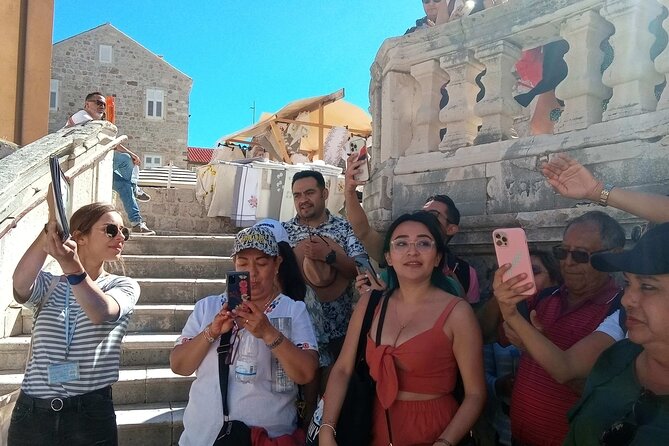
Dubrovnik clicks into place on a short walk. I love how this tour pairs Onofrio’s Fountain with real, practical city water history, and I love the local guide storytelling that makes the walled streets feel like they have a pulse. One consideration: the old town is busy, so in a couple of open squares you may need to keep your spot and listen closely.
You start at Pile Gate, then work your way through key stops like the Franciscan Monastery and its cloister, the limestone main drag of Stradun, Sponza Palace, Orlando Column, Rector’s Palace, the Church of St Blaise, and the Baroque Cathedral of the Assumption. It runs about 1.5 hours, and it is offered in English.
This is also a solid value pick if you want the highlights without turning your day into an all-stair workout. The group size caps at 16, and past guides have been praised for keeping the pace friendly, answering questions, and even steering people toward shade when the sun is doing its thing.
In This Review
- Key highlights to look for
- Pile Gate to Stari Grad: why the start matters
- Onofrio’s Fountain and the aqueduct you can trace in your mind
- Franciscan Monastery: the cloister, the pharmacy, and the Pieta
- Stradun: the main street that holds the city together
- Sponza Palace and the State Archives connection
- Orlando Column: the clock that uses two numeral systems
- Rector’s Palace and Church of St Blaise: civic power meets patron pride
- Dubrovnik Cathedral of the Assumption: Baroque rebuilding after disaster
- How the 90 minutes tends to feel in real life
- Price and value: what $31.46 buys you here
- Who should book this Dubrovnik Old Town tour?
- Should you book this Dubrovnik Old Town Walking Tour?
- FAQ
- How long is the Dubrovnik Old Town Walking Tour?
- What time does the tour start?
- Where do I meet the guide?
- Do I receive a mobile ticket?
- What is the maximum group size?
- How much does it cost?
- What’s included, and what’s not?
- Does the tour depend on weather?
Key highlights to look for
- Pile Gate to Stradun orientation: you get a clean first-day route through Stari Grad
- Onofrio’s Fountain water story: aqueduct history you can actually picture
- Franciscan Monastery cloister and pharmacy: one of Europe’s oldest still-working pharmacy traditions, plus art in the cloister
- Orlando Column time oddity: Arabic and Latin numerals that update only every five minutes
- Cathedral of the Assumption context: 18th-century rebuilding after the earthquake that destroyed the original
Pile Gate to Stari Grad: why the start matters

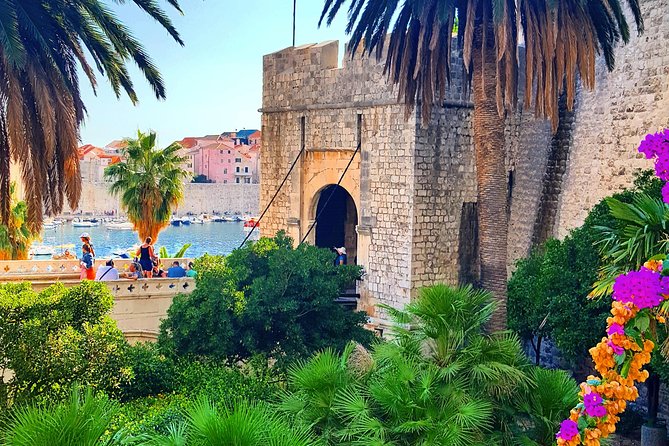
The tour begins at Pile Gate, the western entrance into Dubrovnik’s Old Town. Starting here is smart because it gives you a clear “before and after” moment. Outside the walls, Dubrovnik feels like a modern coastal city. Right inside, it turns into a maze of stone lanes where every turn has history behind it.
From the first minutes, your guide frames what you are seeing in plain terms: how the city grew, what shaped its layout, and why certain buildings sit where they do. I like this approach because it helps you stop treating Dubrovnik like a postcard and start treating it like a real place with a timeline.
If you are trying to choose what to do on your first morning, this is a good option. You walk the central spine of Old Town at a comfortable pace, and you leave with a map in your head for what to return to later.
Onofrio’s Fountain and the aqueduct you can trace in your mind
One of the earliest stops is Onofrio’s Fountain, a multi-faucet drinking fountain tied to an aqueduct that carried drinking water into the city for centuries. The fun part is that this is not just a pretty feature on a square. It connects you to the practical question every medieval city had to solve: how do you keep people alive when water comes from far away?
The tour’s water angle also makes Dubrovnik feel more human. You start noticing details you might otherwise skip, like how the fountain connects to the broader idea of infrastructure. You are standing in a place where everyday needs showed up in architecture.
Also, because this is near the beginning of the walk, it is a great early payoff. You do not have to sweat through multiple turns before you hit a major “wow” moment.
More routes through the Stradun side streets:
- Dubrovnik: Old Town Walking Tour
★ 4.8 · 5,174 reviews - Dubrovnik Discovery Old Town Walking Tour
★ 5.0 · 4,458 reviews - Dubrovnik Old Town History Walking Tour
★ 5.0 · 1,684 reviews - Dubrovnik Combo: Old Town & Ancient City Walls
★ 5.0 · 1,019 reviews
Franciscan Monastery: the cloister, the pharmacy, and the Pieta
Next up is the Franciscan Monastery and Church area, famous for housing one of the oldest still-functioning pharmacies in Europe. In many cities, you can see religious spaces and move on. Here, you get a combo that makes sense: faith, daily life, and care.
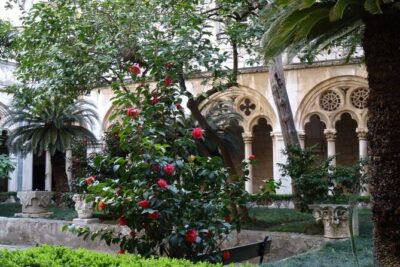
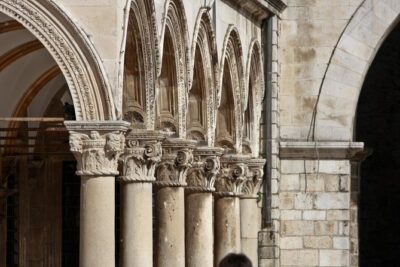
The cloister is the standout. It is Gothic and 14th-century, and the tour helps you look beyond the walls. You get time to slow down and spot art and features you would likely miss if you were rushing. You’ll also hear about the restored sculpture of the Pieta, which adds an emotional layer to what is otherwise stone and history notes.
A drawback to expect, just as a general Dubrovnik reality: this part of town can get crowded, and some seating or resting spots can be limited depending on the flow of people. If you know you get impatient in tight spaces, bring that awareness with you, and lean on your guide for timing and pacing.
Stradun: the main street that holds the city together
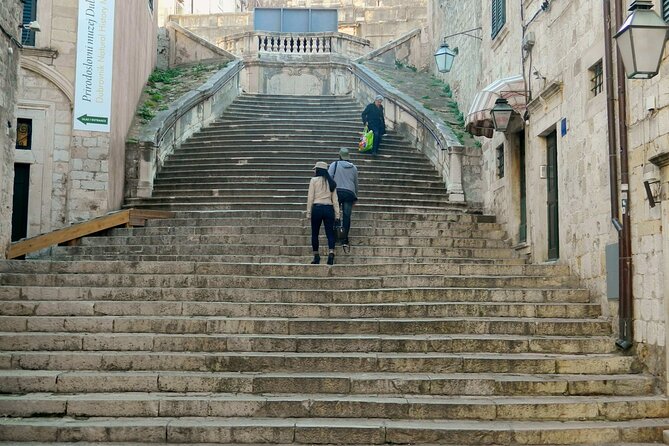
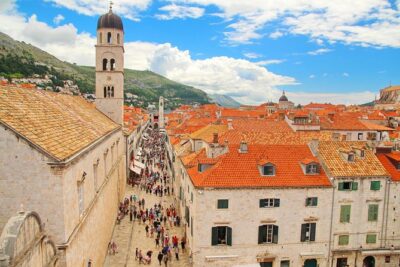
Then you move to Stradun, the limestone-covered main pedestrian street of Dubrovnik. Stradun is where the city’s public life shows up. It is wide enough to feel like a stage, but narrow enough that the walls and buildings always feel close.
What I like about reaching Stradun on this tour is that it acts like a spine. As you walk, you start recognizing landmarks and understanding how they relate. You are not just seeing buildings one by one. You are learning how the layout guides movement, trade, and attention.
If you are hoping to avoid a heavy climbing day, this route is a good fit. One of the best bits of feedback from people who did this early in their trip is that it gives you strong orientation without forcing you into the wall-trekking and stair-heavy plans some visitors choose.
Sponza Palace and the State Archives connection

As you continue, the tour passes by Sponza Palace, a Renaissance-era highlight that now houses the State Archives. Even if you are not a document-nerd, the point here is compelling. This is where the city’s civic identity gets preserved, not just displayed.
Sponza Palace also works well as a “pause and look” stop. Your guide can point out architectural details and explain why this kind of building mattered for a city that relied on administration, commerce, and legal order. In other words, it is not history as dates only. It is history as institutions.
If you want your tour to help you plan a smart return visit later, this is one of the places where you might think, okay, I need to see more closely.
Orlando Column: the clock that uses two numeral systems

Orlando Column is one of those stops that turns facts into fun. You’ll see the clock tower and learn about its unusual detail: it shows time in Arabic and Latin numerals, and it only changes every five minutes.
This is a small thing, but it is the kind of small thing that makes the tour worth it. It gives Dubrovnik a quirky personality and gives your brain an easy hook. Instead of remembering a list of stops, you remember a single moment of odd accuracy.
If you are traveling with kids, it is a natural “spot the difference” moment. If you are traveling as an adult, it is still a great way to break up the day and keep the walking interesting.
More of the old city crossed on foot:
- Dubrovnik: Game of Thrones Walking Tour★ 5.0 · 1,732 reviews
- Dubrovnik: City Walls Early Morning or Sunset Walking Tour★ 4.8 · 1,523 reviews
- Dubrovnik: Ancient City Walls & Wars Walking Tour★ 5.0 · 1,270 reviews
- Dubrovnik: City Walls, Old Town Walking Tour & Adriatic View★ 4.9 · 982 reviews
- Dubrovnik: Game of Thrones Walking Tour★ 4.9 · 981 reviews
Rector’s Palace and Church of St Blaise: civic power meets patron pride
As the tour moves through the square area, you will see the Rector’s Palace and the Church of St Blaise. This is where the walk connects religion, leadership, and identity.
St Blaise is Dubrovnik’s patron saint, and hearing that context changes how you view the church. It is no longer just a landmark. It becomes part of how the city understood itself.
The Rector’s Palace is similar. Even if you only see the exterior at this stage, your guide’s commentary helps you understand why a government seat would stand so prominently. In Dubrovnik, leadership was not hidden. It was built into the urban landscape.
If you love architecture, this section is a strong payoff because it links style to function. And if you are more into history than details, it still gives you a clear idea of how Dubrovnik structured authority and community.
Dubrovnik Cathedral of the Assumption: Baroque rebuilding after disaster
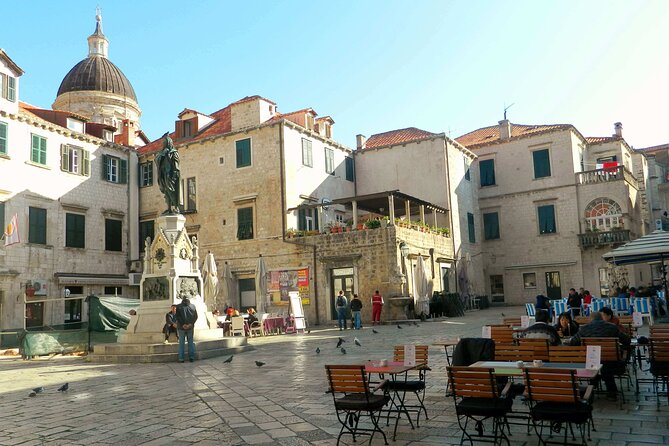
The last major highlight is the Cathedral of the Assumption, a beautiful Baroque sanctuary built in the 18th century after an earthquake destroyed the original cathedral. This stop is powerful because it gives you the city’s resilience without turning it into doom-and-gloom.
Your guide’s commentary helps you understand why rebuilding mattered so much. After destruction, what gets rebuilt tells you what a community believes should remain. For Dubrovnik, the cathedral was not optional. It was central to identity.
If you want a visual contrast, this is a great ending point. Earlier stops feel like the city’s continuity through older structures and traditions. Here, you see how Dubrovnik absorbed disaster and continued.
How the 90 minutes tends to feel in real life
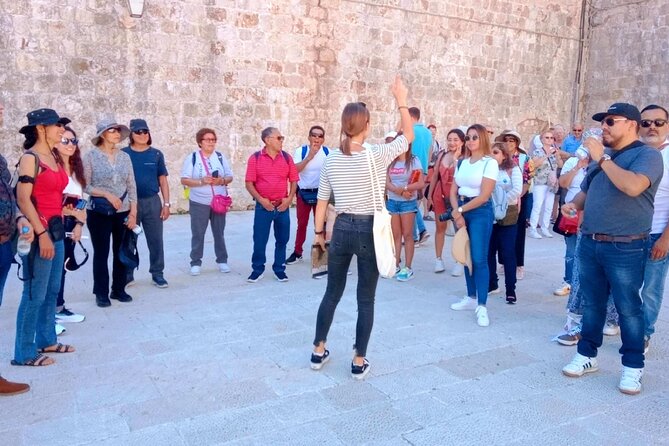
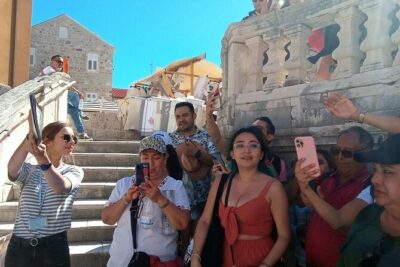
This tour runs about 1 hour 30 minutes, and it keeps moving while still leaving space for short stops and questions. The group size max is 16, which generally means you are not lost behind a giant crowd. That matters because the tour depends on listening. You want to catch the stories that stitch the sights together.
A helpful thing to plan for is sun and heat. Dubrovnik can be bright, and the old town is stone and open squares. Several guides have been praised for being thoughtful about pausing in shade. That does not mean you will have zero sun exposure, but it suggests you should still dress for weather and bring a small bottle of water.
If you prefer quieter “walk and learn” experiences, this is a good fit. If you are very hard to hear in busy streets, try to choose a spot close to your guide, and do not be shy about adjusting your position.
Price and value: what $31.46 buys you here
At $31.46 per person, you are paying for an organized route plus a local guide who knows what to point out. For Dubrovnik Old Town, that matters. If you try to self-tour without a plan, you end up distracted, and you miss the small details that make buildings meaningful.
This tour is also priced like a practical orientation, not a museum day. You get major landmarks, a storyline for what you are seeing, and enough context to decide what to return to later. People who want a first-day overview often like that it does not swallow the whole day.
One value note that I think you’ll appreciate: it is English offered, and it is kept to a short time window. That makes it easier to combine with other plans without forcing your schedule to bend too much.
Who should book this Dubrovnik Old Town tour?
I think this tour is especially good if:
- You want a guided overview early in your trip, so you know what to prioritize later
- You care about street-level context, not just standalone photo stops
- You prefer a manageable walk instead of a full wall-walking day
- You like asking questions and getting answers from a guide who can share local perspective
It is also a good choice if you are traveling solo or as a couple and want a smaller group. Past experiences with guides such as Elvis, Toni, Natalia, Kat, Sara, and Tihomir have been praised for being engaging, friendly, and attentive.
Should you book this Dubrovnik Old Town Walking Tour?
Yes, if you want the quickest path to understanding Dubrovnik Old Town. This is a high-return, morning-friendly way to connect the big sights to the real reasons they matter: water systems at Onofrio’s Fountain, daily-life traditions at the Franciscan monastery, civic identity around Sponza and the Rector’s Palace, and rebuilding at the Cathedral of the Assumption.
Skip it only if you already feel confident navigating Stari Grad on your own and you do not care about explanations. In that case, you might prefer a self-guided stroll. But if you want the city’s highlights with a clear storyline and a pace you can actually keep up with, this tour is a very sensible start.
FAQ
How long is the Dubrovnik Old Town Walking Tour?
It lasts about 1 hour 30 minutes.
What time does the tour start?
The start time is 10:30 am.
Where do I meet the guide?
The meeting point is Elite Travel Walking Tours, Brsalje ul. 1, 20000, Dubrovnik, Croatia.
Do I receive a mobile ticket?
Yes, the tour uses a mobile ticket.
What is the maximum group size?
The tour has a maximum of 16 travelers.
How much does it cost?
The price is $31.46 per person.
What’s included, and what’s not?
A local guide is included. Hotel pickup and drop off are not included, and food and drinks are not included unless specified.
Does the tour depend on weather?
Yes, it requires good weather. If it is canceled due to poor weather, you will be offered a different date or a full refund.
New around Dubrovnik


Old Town Walks, compared.
Dubrovnik Combo: Old Town & Ancient City Walls
Read our review →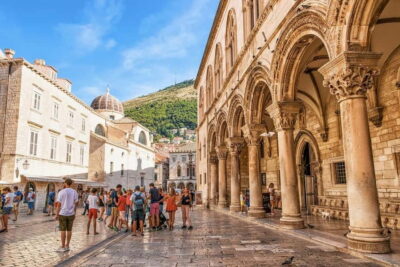
City Walls, Old Town Walking Tour & Adriatic View
Read our review →

Browse the lists this tour appears in